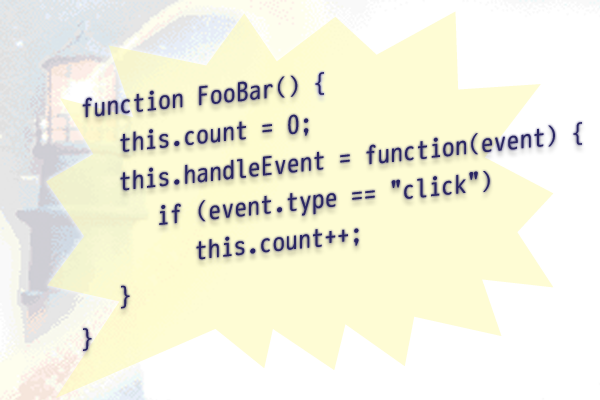
Tales of event-handling in JavaScript and some historic oddities of Netscape Navigator 4.
An interesting aspect of web technology is that solutions to specific problems tend to be invented more than once. For some reason or the other, a given solution doesn’t catch on and a new generation of developers will eventually address the wheel by the help of a new proposal. In this case it’s about object isolation and event handling.
And while we’re at it, we may have a closer look at some of the (other) oddities of the Netscape Navigator 4 browser, as well…
The Terminals Working Group proposed a new Unicode range earlier this month (Jan. 4, 2019) for the purpose of retrocomputing and emulation. As of version 1.1, the newly proposed glyphs are already included in the Char8.js library for generating 8-bit characters from Unicode.
Here’s a sample, rendering the new glyphs in double height using a 16 × 8 character matrix:
The proposed range incorporates glyphs from various legacy systems, including
Reverse engineering the command and control structure of a Wordpress attack.
Software archeology usually relates to dated programs, like the bit we did on a 1960s graphics demo for the PDP-1. However, the same skill set also applies to reverse engineering more recent bits and bytes. In this case it’s about a Wordpress attack and its command & control structure. Recently, I discovered a new variation of the command & control structure…
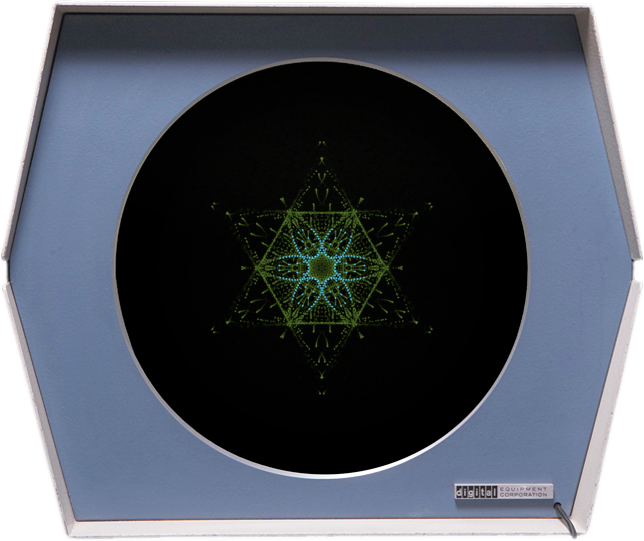
Software archeology of an early computer animation (1960s) for the DEC PDP-1
Snowflake (compare the post below) is a small graphics program written for DEC PDP-1 somewhen in the early to mid 1960s. In essence, Snowflake is a kaleidoscopic program, mapping a list of moving points multiple times onto the screen in a starlike manner. It may be the first of these programs, at least, it’s an early specimen of the species.
In order to learn how it does its trick, we engage in a bit of serious software archeology. All the fun is provided: PDP-1 assembler code, intricacies of display instructions, disassemblies, we even provide a little hack of our own to demonstrate the algorithm (which happens to be much like an once original form and isn’t without a beauty of its own). However, strap yourself for a lengthy read…
Portraits have always been a means of self-celebration and display, both of figure and social status, but also a means of reading – not only of physiognomy, but also of the essence of a person. By the democratization of photography and increasing accessibility of technological tools the portrait in its current form of the selfie hasn’t only become ultimately linked to narcissism, but has also become a means of linking over social networks and accumulating symbolic wealth on the respective status page, the new symbolic home.
Image: Dito von Tease, 2018.
Dito von Tease, a Bologna (Italy) based digital artist, has ingeniously mixed the two forms, the traditional portrait and the selfie, “showing subjects [of traditional art] in authentic and modern selfie poses. An iconoclastic project that blends together two apparently heterogeneous aesthetics, creating an ironic and surprising result.”
It may be just the right season to remind of one of the first computer animations, “Snowflake” written in the 1960s for the DEC PDP-1. Despite various research efforts, the author of this amazing little program remains still unknown, which is quite a bity, since s/he deserves to be rembered along with the program.
Observations on information spread and authenticity of well-known objects on the Internet. (Also, a visual whodunit. And a new reference image.)
When I was recently reviewing various versions of image files representing Charles Joseph Minard’s famous chart of Napoleon’s Russian Campaign of 1812-1813 from 1869 for my discussion of the subject (see below), I noticed something peculiar: While there are various scans of the graphic available on the Web, in varying resolution and compression quality, almost all of them seem to depict a single, uniform object. However, there are just a few exceptions. Notably, these exception differ in the weight of the black print, especially the stroke widths of any black lines and by this the overall balance, and color. Most notably, these few exceptions can be traced back to just two authentic sources, both official image from French libraries. Something peculiar seems to be going here. — Time to investigate…